The Origins of Buddhist Art After the Life of Siddhartha Gautama
The Origins of Buddhist Art After the Life of Siddhartha Gautama
Introduction
Buddhist art is one of the world's oldest and most influential artistic traditions, spanning more than two millennia and inspiring countless sculptures, paintings, temples, and monuments across Asia. Today, images of the Buddha are instantly recognizable, symbolizing wisdom, peace, compassion, and enlightenment. However, few people realize that during the earliest centuries of Buddhism, followers did not create statues of the Buddha in human form.
The journey from symbolic representations to the beautifully crafted Buddha sculptures admired today is a remarkable story of religious devotion, cultural exchange, and artistic innovation. This evolution not only shaped Buddhist worship but also laid the foundation for the exceptional metal craftsmanship that later flourished in Nepal, particularly in the Kathmandu Valley. Today, artisans continue this centuries-old tradition by creating handcrafted Buddha sculptures using techniques passed down through generations.
The Life and Teachings of Siddhartha Gautama
Around the 5th century BCE, Siddhartha Gautama was born in Lumbini, in present-day Nepal, into the Shakya royal family. Although raised in luxury, he became deeply troubled by the realities of aging, illness, and death. Determined to understand the nature of human suffering, he renounced his royal life and embarked on a spiritual quest.
After years of meditation and disciplined practice, Siddhartha attained enlightenment beneath the Bodhi Tree in Bodh Gaya, India. From that moment, he became known as the Buddha, meaning "The Enlightened One."
For approximately forty-five years, the Buddha traveled throughout northern India, teaching the Dharma—the path to wisdom, ethical living, and liberation from suffering. His teachings emphasized compassion, mindfulness, non-violence, and the pursuit of inner awakening rather than the worship of a deity.
After his passing, known in Buddhism as Mahāparinirvāṇa, his disciples preserved his teachings orally for generations before they were eventually recorded in written form. These teachings became the foundation of one of the world's major religions.
Early Buddhism and the Absence of Buddha Statues
One of the most fascinating aspects of early Buddhist history is that the earliest followers did not represent the Buddha with human images. Instead, they expressed his presence through powerful symbols that conveyed his teachings without depicting his physical form.
This period, often called the aniconic phase of Buddhist art, reflected a deep respect for the Buddha's enlightenment rather than his physical appearance. Many scholars believe that early Buddhist communities wished to emphasize the timeless nature of the Dharma rather than encourage personal veneration of the historical Buddha.
Instead of statues, artists used symbolic imagery, including:
The Bodhi Tree, representing the place where enlightenment was attained.
An empty throne, symbolizing the Buddha's spiritual presence.
The Dharma Wheel (Dharmachakra), representing the teaching of the Dharma and the beginning of the Buddha's first sermon.
Footprints (Buddhapada), signifying the Buddha's presence on Earth and the path he walked.
The Stupa, representing the Buddha's relics, enlightenment, and the path toward liberation.
The Lotus Flower, symbolizing purity, spiritual awakening, and enlightenment emerging from the challenges of worldly existence.
These symbols appeared extensively on railings, gateways, relief carvings, coins, and early monuments throughout ancient India.
The Great Stupas: The First Centers of Buddhist Art
Following the Buddha's passing, his relics were distributed among various kingdoms and enshrined within stupas—hemispherical monuments built as sacred places of remembrance and pilgrimage.
During the reign of Emperor Ashoka in the 3rd century BCE, Buddhism expanded dramatically across South Asia. Ashoka commissioned hundreds of stupas, monasteries, pillars, and inscriptions, helping establish Buddhist architecture and artistic traditions on an unprecedented scale.
Sites such as Sanchi, Bharhut, Amaravati, and other early Buddhist monuments became important centers where artists developed increasingly sophisticated stone carvings. Although these monuments contained elaborate narrative reliefs illustrating stories from the Buddha's life and previous births (Jataka tales), the Buddha himself continued to be represented symbolically rather than as a human figure.
This symbolic approach reflected both religious philosophy and artistic convention during the early centuries of Buddhism.
The Transition Toward Human Representation
By the first century CE, Buddhism had spread far beyond its original homeland. Expanding trade networks, interaction with diverse cultures, and the growing devotional practices of Buddhist communities gradually influenced artistic expression.
As Buddhist philosophy evolved, followers increasingly sought visual representations that could serve as objects of meditation, teaching, and devotion. This cultural shift eventually led artists to create the first human images of the Buddha.
Two major artistic centers played a defining role in this transformation:
Gandhara
Located in present-day northern Pakistan and eastern Afghanistan, Gandhara became a crossroads of Indian, Persian, Central Asian, and Hellenistic cultures following the campaigns of Alexander the Great.
Artists in Gandhara introduced remarkably realistic sculptures characterized by flowing robes, natural facial features, wavy hair, and balanced proportions influenced by classical Greek sculpture. These works represent some of the earliest surviving human depictions of the Buddha.
Mathura
At approximately the same time, artists in Mathura, northern India, developed a distinctly Indian artistic tradition. Their Buddha images featured stronger physiques, simplified robes, gentle expressions, and symbolic hand gestures known as mudras.
Although Gandhara and Mathura differed stylistically, both schools profoundly influenced the future of Buddhist sculpture throughout Asia.
The Birth of an Enduring Artistic Tradition
The emergence of Buddha sculptures marked a turning point in Buddhist history. Images of the Buddha became powerful educational and devotional tools, helping communicate philosophical ideas to communities across different cultures and languages.
As Buddhism spread along the Silk Road into Central Asia, China, Nepal, Tibet, Korea, Japan, Sri Lanka, and Southeast Asia, local artisans adapted the Buddha's image to reflect regional artistic traditions while preserving core symbolic elements.
Over time, artists also created images of Bodhisattvas, Taras, guardians, and other enlightened figures, expanding the rich visual language of Buddhist art.
The Foundation for Nepal's Master Craftsmen
The transition from symbolic imagery to sculptural representation laid the foundation for one of the world's most respected artistic traditions: the Buddhist metalwork of Nepal.
When Buddhism flourished in the Kathmandu Valley, Newar artisans transformed inherited artistic knowledge into an extraordinary tradition of bronze casting, repoussé work, stone carving, wood carving, and fire gilding. Their mastery of the ancient lost-wax casting process enabled them to produce sculptures renowned for their intricate detail, spiritual expression, and technical excellence.
For centuries, monasteries, temples, collectors, and royal patrons from Tibet, Bhutan, China, and the Himalayan region commissioned Buddha statues from Nepali craftsmen. These works became celebrated not merely as works of art but as sacred objects embodying profound spiritual meaning.
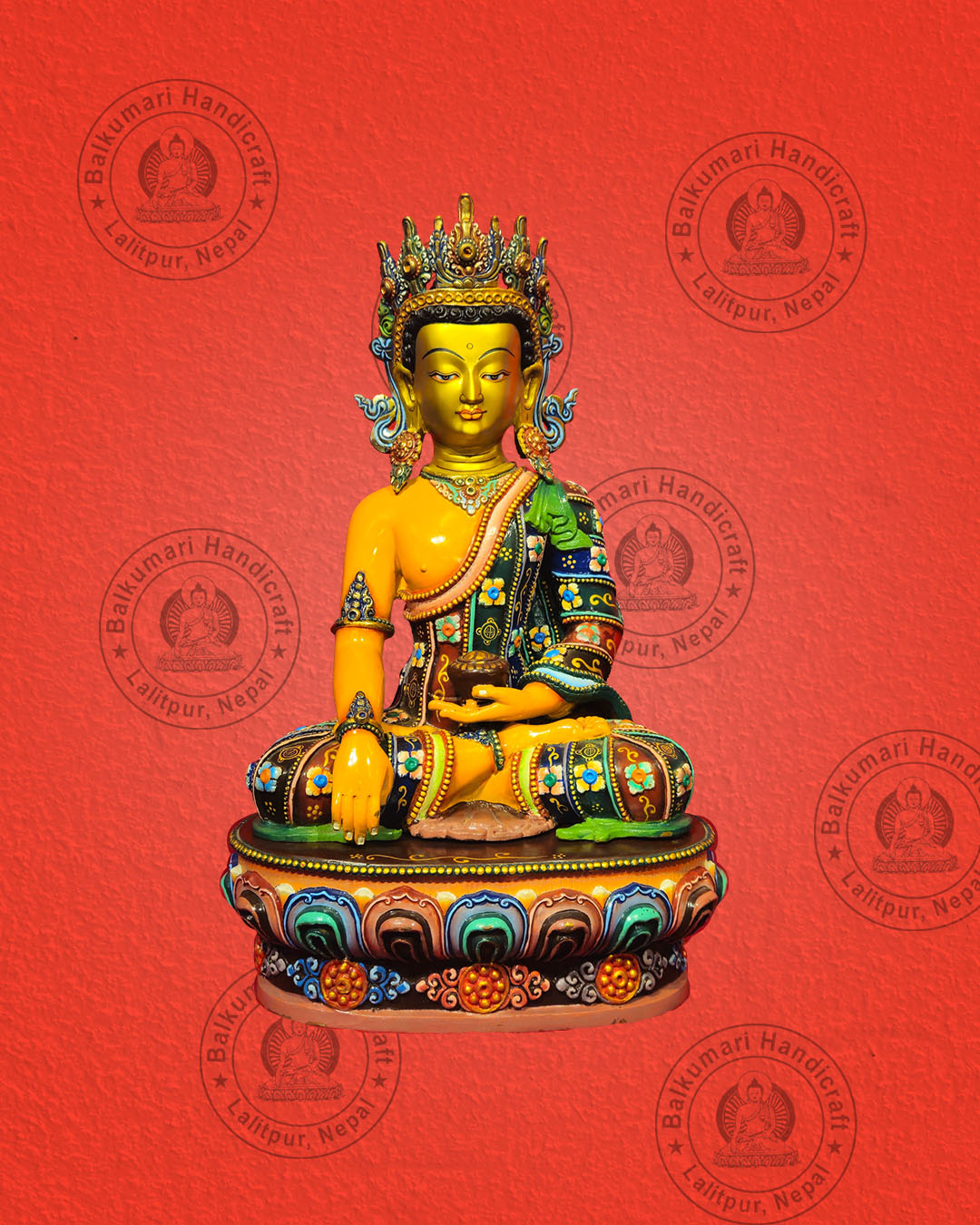
Today, workshops such as Balkumari Handicraft continue this remarkable legacy by preserving traditional craftsmanship while sharing authentic Nepali Buddhist art with collectors and devotees around the world.
Conclusion
The origins of Buddhist art reveal a fascinating evolution from simple symbolic representations to the magnificent handcrafted Buddha sculptures admired today. Rather than immediately portraying the Buddha in human form, early Buddhists chose symbols that reflected his teachings and enlightenment. As Buddhism expanded across Asia, artists gradually developed human representations that became central to Buddhist devotion and artistic expression.
This journey ultimately inspired centuries of craftsmanship, culminating in the world-renowned metalworking traditions of Nepal. Every authentic handcrafted Buddha statue carries within it not only artistic beauty but also a living heritage that connects modern artisans with more than two thousand years of Buddhist history, philosophy, and devotion.
Interested in Authentic Nepali Handicrafts?
Browse our collection or contact us directly on WhatsApp for personalized recommendations.